



Market Update: Perspective & Actions We’ve Taken
The markets the past couple weeks have been volatile, so we wanted to reach out. During these moments of uncertainty our goal is always to provide perspective. News headlines on Iran, oil prices, and stock market swings can send mixed messages, so we want to make sure you're informed on what matters most to your financial progress and what we are doing on your behalf.
What’s happening…
The ongoing conflict in the Middle East has been the primary driver of stock market swings recently. Brent crude oil climbed back above $109 per barrel, raising questions about whether higher energy costs could slow economic growth and push inflation higher. This adds to existing concerns such as the impact of artificial intelligence, broad market valuations, and the path of Federal Reserve policy.
Has HSWS made any changes…
Yes, we added a small portion of stock to your accounts last week. This past week, the market, as measured by the S&P 500, fell 10% intraday from its most recent all-time high set in February 2026. This threshold triggers our investment management process to strategically increase stock positions within your portfolio. Our objective is to capitalize on these lower prices while ensuring that you maintain appropriate equity exposure throughout various market cycles, ultimately aligning with your long-term financial goals.
We believe that periods of uncertainty often lead to significant long-term opportunity. Staying invested and slightly adding to equities during these times can help capitalize on the eventual market recovery, rewarding those who maintain a disciplined approach and are committed to their long-term investment strategies. We believe navigating through these environments is a more successful strategy in the long run than trying to avoid them or selling into them.
Still, markets that lack a clear direction can feel uncomfortable. In times like these, it's more important than ever to not lose sight of long-term goals and investing principles. Here are some perspectives we hope you find helpful.
Market Pullbacks Are a Normal Part of Investing
The stock market has been choppy this year, with the S&P 500 experiencing its first pullback of 10% or more this year. It's important to remember that pullbacks around this size are completely normal, and the market is still up significantly over longer time periods. In 2025, for example, there were six 5% or worse pullbacks for the S&P 500 driven primarily by tariffs, yet the market still generated a return of 16% for the year. Here are the links to the letters we sent out during that time: Finding Perspective & Opportunity…, Navigating Market Volatility…, and How to Navigate Retirement Income in Uncertain Markets.
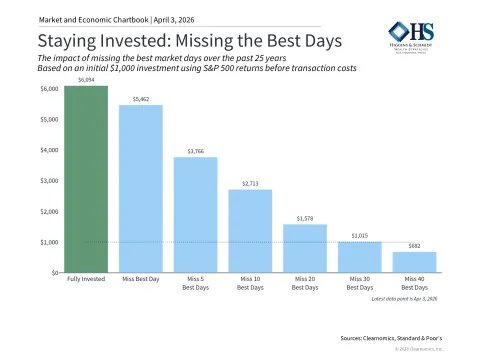
This is the foundation of why staying invested and taking advantage of lower stock prices has historically been the best approach. Some may be tempted to time the market, but the challenge is twofold - knowing when to get out, and also knowing when to get back in. The market's best days have often occurred shortly after its worst days, so investors who step to the sidelines often miss the very rebounds they were waiting for.
This is not to say that pullbacks are insignificant or that markets always rebound quickly. Rather, they are a normal part of investing that should be planned for, not reacted to.
What about gas prices…
While the stock market gets most of the headlines, one of the most direct ways the conflict in Iran affects everyday life is through the price of gasoline at the pump. The national average for regular unleaded climbed to $4.09 per gallon as of April 3rd and in Colorado $3.85, an increase of over 80 cents in just one month. The actual gas prices we see at the pump are often higher due to taxes and other costs.
It's also important to recognize the indirect effects. Gasoline and diesel are basic inputs into nearly everything the economy produces. Transportation, manufacturing, agriculture, and distribution all depend on energy, which means that higher fuel costs can raise the price of goods and services across the board.
Financial markets and the economy overcame similar challenges in 2022. Gas prices hit a record high of $5.00 per gallon then, above where they are today. And yet, portfolios performed very well over the next few years once the market began to recover.
Comparisons are also drawn to the 1970s during the Arab oil embargo, which resulted in long lines at gas stations and rationing. Today's situation is quite different since the U.S. is now the world's largest oil and natural gas producer. For investors, this means that the best approach continues to be staying invested with a well-constructed portfolio and financial plan.
Thoughts for Your Portfolio…
While there are considerations across each asset class, the past few weeks highlight the power of a properly constructed portfolio. Today, assets like commodities and sectors such as Energy are leading the way. However, this is not about trying to guess what will outperform next. Instead, it is about benefiting from the full range of market movements so that when one part of a portfolio struggles, another may provide balance.
Your portfolio is designed precisely to navigate environments like this one. History consistently shows that making dramatic portfolio changes in response to geopolitical events and market swings is often counterproductive.
We are monitoring the situation carefully and will keep you informed of any meaningful developments. In the meantime, please don't hesitate to reach out if you have any questions or simply want to talk through what this means for your plan. We are available and would love the opportunity to discuss.
Sincerely,
Allie & Steve